

Insights
4 min read
Insights
7 min read
Written By: Patrick Sims, General Manager of Growth and Strategy
Selecting a construction delivery method is one of the most consequential decisions an owner makes on a project. It sets the course for how risk is allocated, how budget is managed, how quickly work moves, and how collaborative the experience is.
In today’s landscape—marked by supply chain variability, workforce constraints, funding deadlines, and public scrutiny—delivery methods are a strategic choice that can either reinforce or undermine a project’s success. AP delivers projects through many delivery methods, including Design-Bid-Build, Construction Manager at Risk, and Design-Build, and understands no single approach is “the best.” The right choice depends on schedule and budget flexibility, project complexity, and owner internal capacity.
Understanding how each method functions in practice helps owners align delivery strategy with project realities.
Start with the right questions
Before choosing a delivery method, owners benefit from stepping back and pressure-testing three questions. These create a decision framework rooted in budget, schedule, and capacity—not precedent.
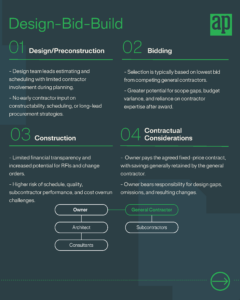
Often called “hard bid,” DBB is a sequential method that separates design and construction. The design team completes full documents, the project is bid, and the lowest bidder is awarded the work.
Where it adds value
DBB works well for smaller, less complex projects with a defined scope, limited phasing, and flexible schedules—for example, a straightforward K–12 classroom renovation. The linear structure can be efficient when major changes are unlikely.
Key considerations
Tradeoffs include limited cost feedback during design and little ability to procure long‑lead items early, since the contractor joins after documents are complete. Owners also have less visibility into contingencies and how risk affects the final price. DBB is a strong option for straightforward work but offers less flexibility when designs evolve or timelines are tight.
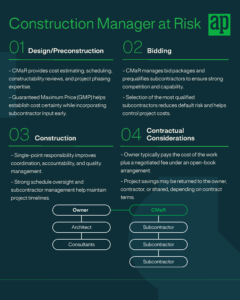 CMAR brings the contractor in during design, changing how budget, schedule, and risk are managed from the beginning. The construction manager collaborates on budgeting, preconstruction, phasing, and scheduling, typically giving owners clear visibility into costs and contingencies.
Where it adds value
CMAR enables early bidding of long‑lead packages and often sets a Guaranteed Maximum Price (GMP) during design, pairing collaboration with cost certainty. This is particularly valuable on schedule‑sensitive projects and adds the most value on higher‑risk, more complex work, such as phased healthcare expansions in occupied facilities or industrial and advanced manufacturing projects where equipment drives the schedule.
Key considerations
Continuous cost checks, flexible sequencing, and transparent use of contingency help reduce change orders and manage schedule risk.
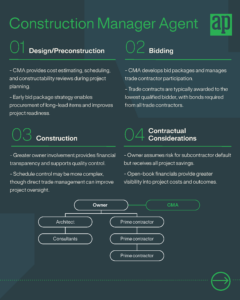 CM Agency is very similar to CMAR in how the construction manager engages during design, leading preconstruction efforts such as estimating, budgeting, scheduling, sequencing, phasing, and early bid packaging. The key difference is contractual. Instead of holding subcontracts, the construction manager acts as an advisor while the owner holds direct contracts with multiple prime contractors. This makes the CM Agency a fee-based professional service rather than the party at risk for construction performance.
Where it adds value
CM Agency is especially effective for public owners, such as school districts, that are required to follow competitive bidding laws or prefer direct control over contractor selection. It provides the same early collaboration and cost insight as CMAR while allowing owners to maintain transparency in bidding and direct relationships with trade contractors. This approach works well when the owner has the internal resources to manage multiple contracts and wants a high level of involvement throughout construction.
Key considerations
Because the owner holds all trade contracts, they also assume greater responsibility for contract administration, insurance, and coordination. The construction manager has less control over subcontractor selection and may have limited ability to disqualify low-performing bidders without documented cause. Success depends heavily on the owner’s capacity to actively manage contracts and partner closely with the CM throughout the project.
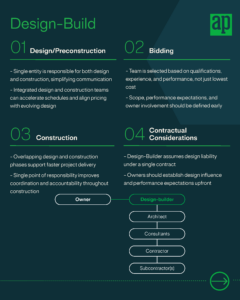
Design-Build places design and construction under a single entity, giving owners one partner to deliver the project end‑to‑end. This single point of responsibility can simplify communication and decisions. Integrated teams can often compress schedules, overlap phases, and align early pricing with evolving design.
Where it adds value
Design-Build is especially effective when speed to occupancy is critical, such as healthcare clinics or industrial and advanced manufacturing facilities where faster capacity impacts revenue.
Key considerations
Design-Build requires clear scope and performance expectations early. Owners should be intentional about how much design influence they want and how they’ll engage in key decisions. Team selection and agreement structure shape owner control. Many owners prioritize qualifications and track record alongside cost.
The AP advantage across delivery methods
Delivery methods set the framework for a project, but don’t determine success on their own. Execution does—and across all models, AP relies on disciplined processes, transparent communication, and deep expertise to help owners manage risk, schedule, and budget.
We help owners work backward from milestones—funding deadlines, school schedules, go‑live targets—to set realistic start dates, procurement strategies, and phasing plans. Aligning priorities early reduces surprises later in design or construction.
Our teams build and maintain risk registers that are reviewed regularly, not just at milestones. This proactive approach surfaces issues early and supports timely decisions around long‑lead equipment, regulatory approvals, and site conditions.
From multi‑phase education facilities to civic buildings and active industrial sites, careful sequencing and communication are essential. We prioritize safety, operational continuity, and budget control by coordinating closely with owners to plan work around specific project and business needs.
In every delivery method, we emphasize clarity around budget, schedule, and scope, so owners understand what decisions are being made and why.
Owners operate in environments where funding windows and public accountability shape decisions, and delivery strategy should reflect those conditions from day one. Within that context, there is no universally “best” delivery method, only the method that best aligns with a project’s complexity and capacity. Early, candid conversations create transparency and set projects up for success.
If you are evaluating options for an upcoming project, AP is ready to help you navigate the decision. Connect with our experts to discuss your goals, and together we can determine the delivery approach that best supports your project’s success.
Insights
4 min read
Insights
7 min read
Insights
3 min read
Insights
5 min read


